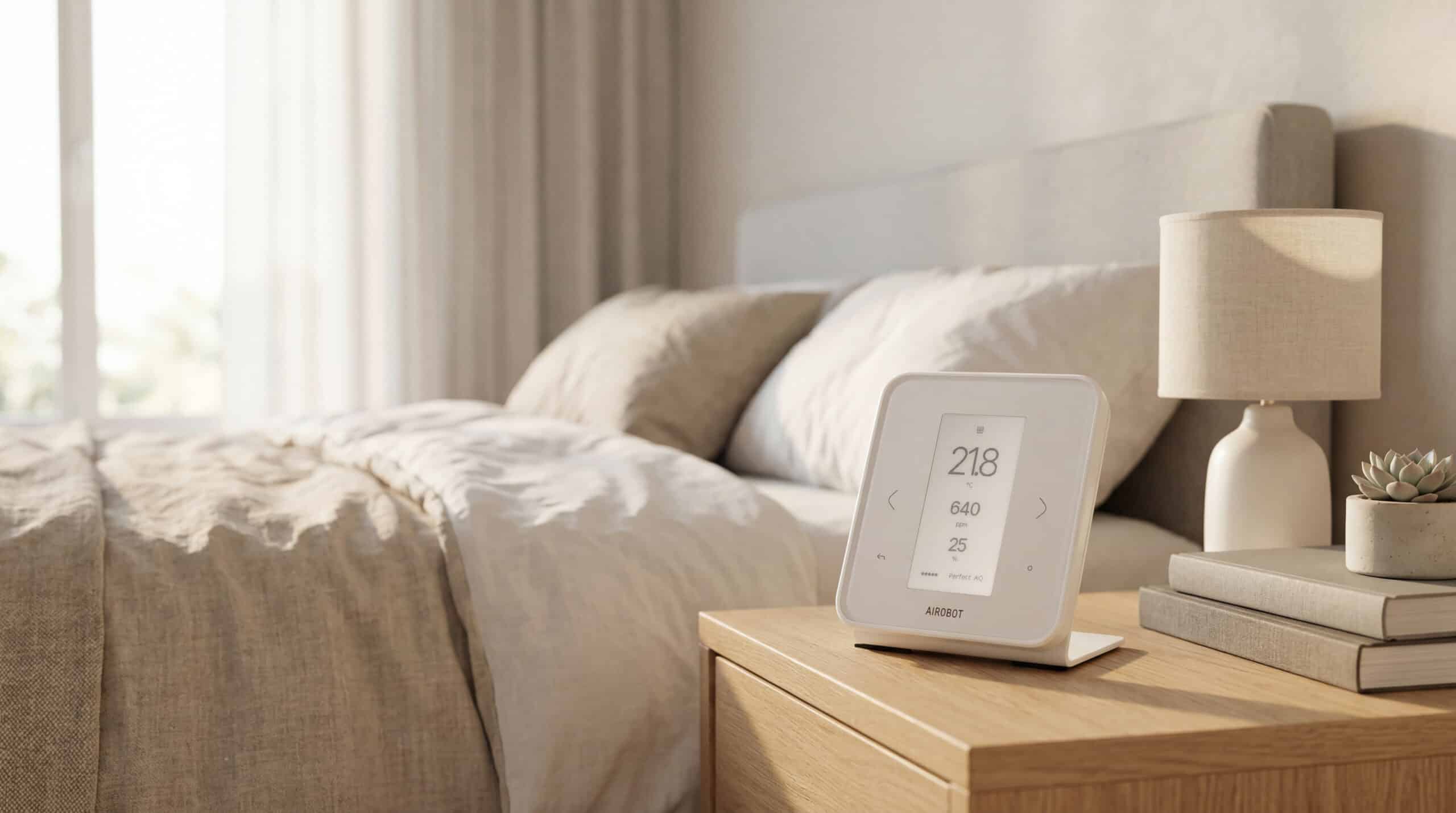
You go to bed at a reasonable hour. The alarm doesn’t go off for eight hours.
But when you wake up, you still feel drained. Sound familiar? You’re not alone.
And the culprit probably isn’t your mattress, stress, or too much screen time. It may be the air you breathe at night.
Bedroom CO₂: What an Air Quality Monitor Measures
Outdoor air typically contains 400–450 ppm of CO₂ (parts per million). That’s a normal level the human body handles well.
But what happens in a closed bedroom where two people breathe through the entire night?
Every breath produces CO₂. Without adequate ventilation, concentrations in a bedroom can exceed 1,000 ppm within an hour — and by early morning, levels often reach 2,000–3,000 ppm. You can’t feel it, smell it, or see it. But your body can.

What Research Says About Bedroom Air Quality
Recent studies have provided clear answers to the question of whether bedroom air quality actually affects sleep.
A 2025 study by Waseda University (Japan) and ASHRAE analysed 17 research papers covering 22 experimental datasets. The conclusion was unambiguous: bedroom CO₂ should remain below 800 ppm to ensure undisturbed sleep. Levels at 1,000 ppm and above measurably disrupt sleep — even in healthy young adults.¹
A 2023 ScienceDirect study tested 36 healthy participants at three CO₂ levels: 750 ppm, 1,000 ppm, and 1,300 ppm. The results: at just 1,000 ppm, sleep efficiency dropped by 1.3% and time spent awake increased by 5 minutes. At 1,300 ppm, deep sleep duration decreased and salivary cortisol — the stress hormone — rose after waking.²
An Australian field study (Sydney, 48 homes) found that for every 100 ppm increase in CO₂, sleep efficiency dropped by an average of 4.3%.³
That’s not a small number. If your bedroom CO₂ averages 1,400 ppm overnight, sleep efficiency could be 40% lower than in a well-ventilated room.
Why Does the Body React?
CO₂ is not directly toxic at normal indoor concentrations. The effect is indirect: elevated CO₂ is a signal that ventilation is insufficient — and alongside CO₂, other byproducts of breathing accumulate in the air.
The body responds subconsciously: breathing rate increases slightly, heart rate doesn’t drop as deeply as it should, and sleep becomes shallower. You wake more often, even if you don’t remember it.
In the morning, the result is clear: you feel tired, thinking feels slower, focus is harder to find.

Air Quality Monitor: How to See What’s Happening in Your Bedroom
Most people can’t answer this question — simply because they’ve never measured it.
An air quality monitor is a device that measures CO₂ levels, humidity, and temperature in real time — and displays them on a clear screen. No calculations needed. The numbers are just there.
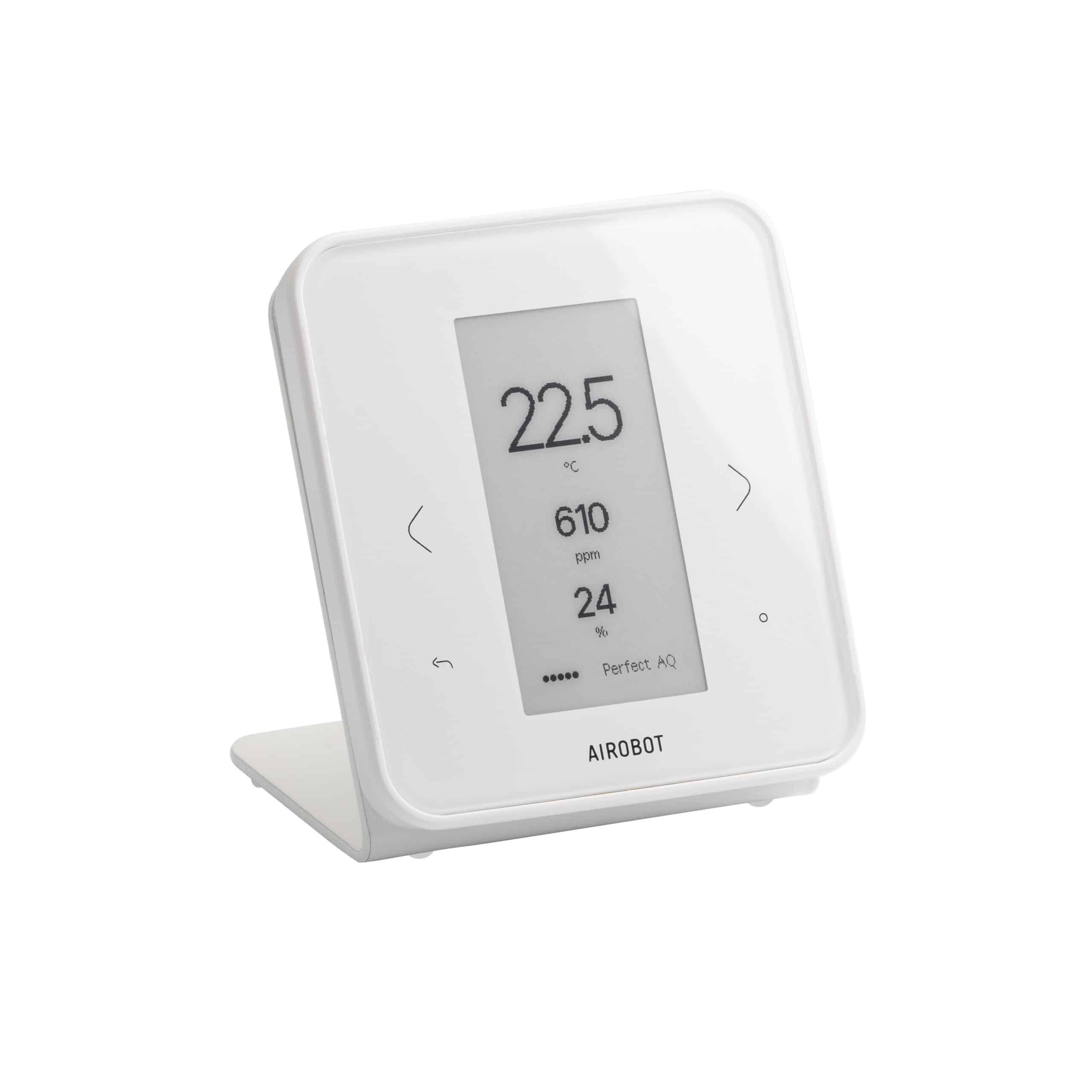
The Airobot air quality monitor shows:
- CO₂ level in ppm — see immediately whether your bedroom air is healthy
- Humidity — air that’s too dry or too humid also affects sleep and airways
- Temperature — the optimal sleeping temperature is 16–19°C
- History up to 7 days — see when CO₂ peaks occur
- The monitor connects wirelessly to the Airobot ventilation unit — when CO₂ rises above a set threshold, the ventilation speeds up automatically. Sleep continues, without lifting a finger.
What You Can Do Right Now
Even without a monitor, a few things help:
- Open a window before bed — ventilate the bedroom for at least 10–15 minutes
- Leave the door open if possible — air can circulate
- Avoid an overly warm bedroom — warm air feels heavier and compounds tiredness
- Check your ventilation — is your home’s ventilation working? When were the filters last changed?
But the long-term solution starts with measurement. You can’t fix what you can’t see.
In Summary: The Air Quality Monitor as a First Step
Waking up tired isn’t always about how long you slept. Often it’s about sleep quality — and sleep quality depends directly on what you breathe at night.
The science is clear: bedroom CO₂ above 1,000 ppm measurably disrupts sleep. Most closed bedrooms exceed that threshold within the first half of the night.
An air quality monitor isn’t a luxury gadget. It’s the first step toward understanding what’s actually happening in your home.
Explore the Airobot Air Quality Monitor →
References
- Akimoto, M. et al. (2025). New research on bedroom ventilation and sleep quality suggests that building standards should be revisited (ASHRAE 1837-RP). Science and Technology for the Built Environment. tandfonline.com
- Klausen, S.S. et al. (2023). Ventilation causing an average CO2 concentration of 1,000 ppm negatively affects sleep: A field-lab study on healthy young people: Building and Environment. sciencedirect.com
- ScienceDirect (2023). Effects of exposure to carbon dioxide and human bioeffluents on sleep quality and physiological responses. Building and Environment. sciencedirect.com