Most people shop for an MVHR system the way they’d shop for a toaster: lowest price wins. But a ventilation system runs every hour of every day, for years. The price tag is just the first page of the story. What happens after you plug it in is the part that actually costs you money.
An independent study from TalTech put this to the test. Here’s what they found, and what it means for your own home.
What an Independent Study Found
Researchers at TalTech modelled a full year of real life in an Estonian home: people coming and going, bedrooms used at night, the living room used by day, real Estonian weather.
They tested several ways of controlling a ventilation system. From one constant speed, up to Airobot’s approach of zonal CO₂ control, where the home is split into zones that each adjust independently.
You can read the summary here.
Or read the full report here.
Zonal control won, by a wide margin. Compared to a constant-speed system, it used:
- 18% less energy heating the home
- 48% less energy heating the incoming fresh air
- 64% less electricity running the fans
- 33% less electricity overall for heating and ventilation combined
Just as important: air quality didn’t suffer to get there. Indoor CO₂ stayed within healthy limits in every room, all year round. You’re not trading clean air for a lower bill — an Airobot MVHR system gets you both.
What That Means for Your Home
Percentages are nice. Euros are nicer.
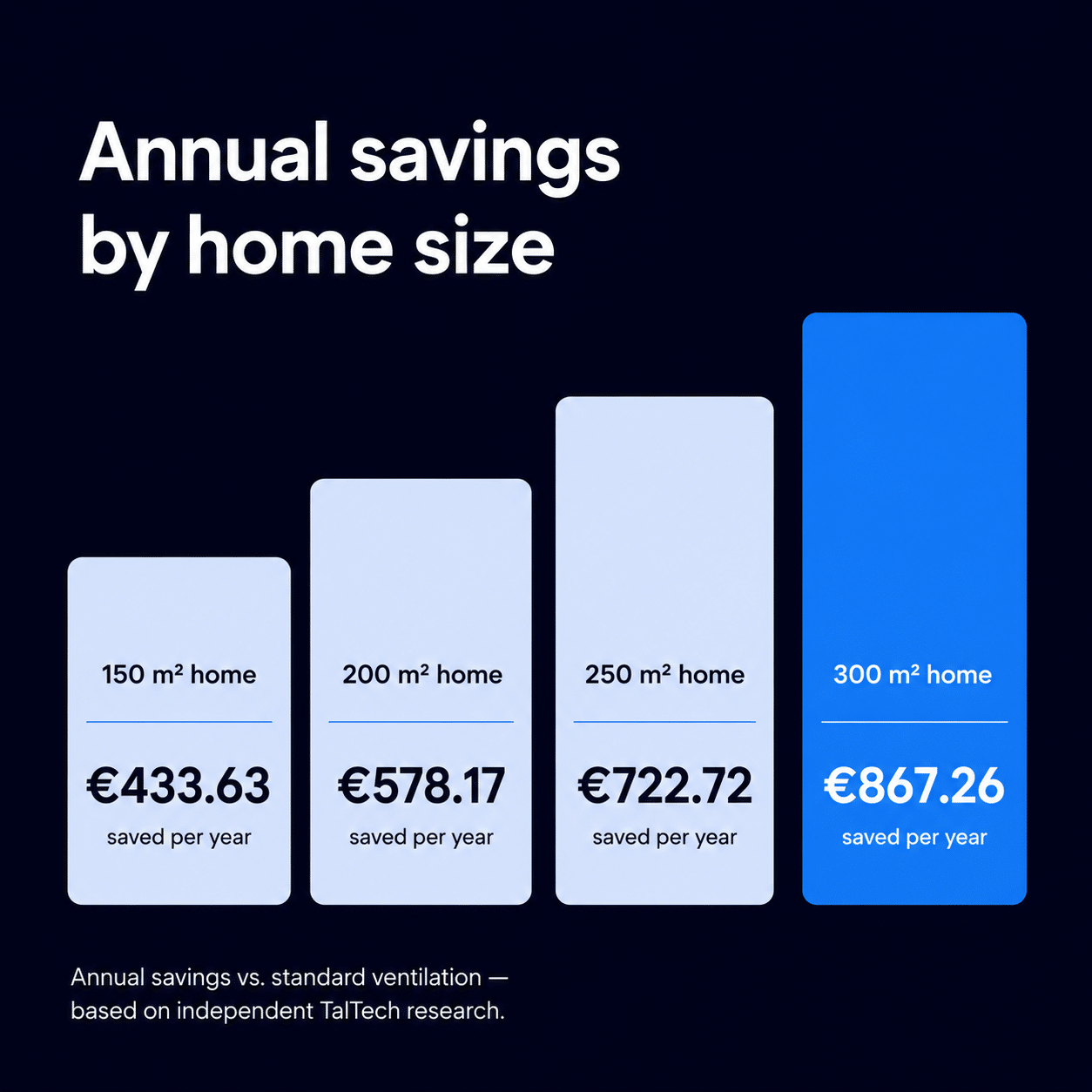
We ran the same model behind our online savings calculator built on this same TalTech research – for a few different home sizes, comparing Airobot’s zonal control against a standard, constant-speed ventilation system.
The bigger the home, the bigger the saving-roughly €2.89 for every square metre, every year. Want your exact number?
So Why Does It Cost More to Buy in the First Place?
Here’s the honest answer: an Airobot unit costs more upfront than a basic, constant-speed ventilation system. We’re not going to pretend otherwise.
It costs more because it’s doing more. Airobot units are built around CO₂, humidity, and air quality sensors, a heat exchanger engineered for up to 96% heat recovery, and the processing power to constantly read the air and adjust itself- automatically, all day.
A basic system has one job: blow air. Airobot has one job too- keep your air healthy and your bills low- but it works much harder, and much more precisely, to do it.
Think of it like a fuel-efficient car. It might cost more at the dealership than the basic model parked next to it. But every month afterwards, you spend less at the pump. Drive it long enough, and the “expensive” car turns out to be the cheaper one to own.
Airobot works the same way. The savings aren’t a one-off event- they happen automatically, every day, for as long as you own the system. Less heating energy. Less fan electricity. Month after month, year after year, with zero effort from you.
At some point- and you can see exactly when, using our calculator- those savings overtake the higher price you paid on day one. After that, every year is pure savings.
It’s Not Just About the Bill
Saving money is one good reason to own an Airobot MVHR system. The better reason is what it does for the air you breathe every day, without you having to think about it.
What We Actually Measure
Most ventilation systems just move air. Airobot measures it first.
- CO₂ – the clearest signal of how “used up” the air in a room is. Studies show CO₂ levels affect sleep, energy, and how well you can concentrate.
- VOCs (volatile organic compounds)- released by furniture, paint, and cleaning products. Airobot detects them and ventilates them out.
- Particulate matter (PM2.5)- fine dust from traffic, candles, and cooking, small enough to affect your lungs. Airobot tracks it and increases airflow when it climbs.
- Humidity – air that’s too dry is hard on your skin, sinuses, and woodwork; air that’s too damp risks mould. Airobot keeps it in a healthy middle ground.
Every one of these is measured continuously, in the actual zones of your actual home – not estimated, not assumed.

On Your Phone, or On the Wall
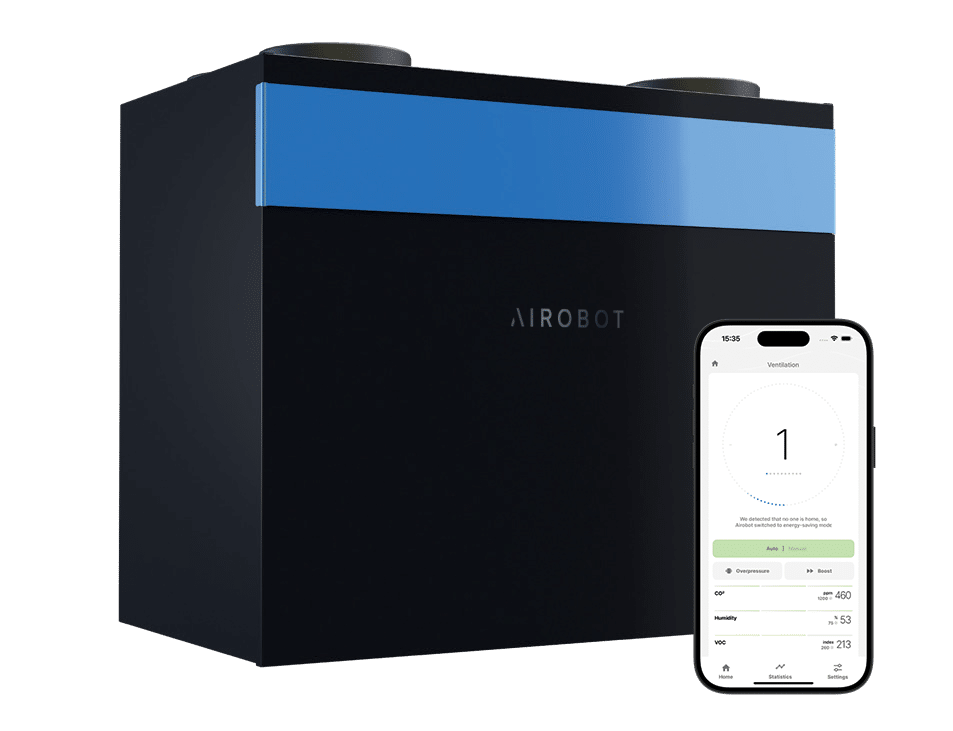
Airobot gives you two ways to see and control it all: the Airobot app on your phone, or Airobot Touch, our wall-mounted touchscreen panel. Use one, use both- it doesn’t matter. They do the same job.
Both show you the same live readings, pulled straight from your ventilation system and room sensors: CO₂, humidity, VOCs, and fine particles, room by room.
Both let you set the temperature for each room and a CO₂ target for the bedroom so you sleep better. Open the app from anywhere, or just glance at the panel on your wall-either way, you always know exactly what’s in the air.
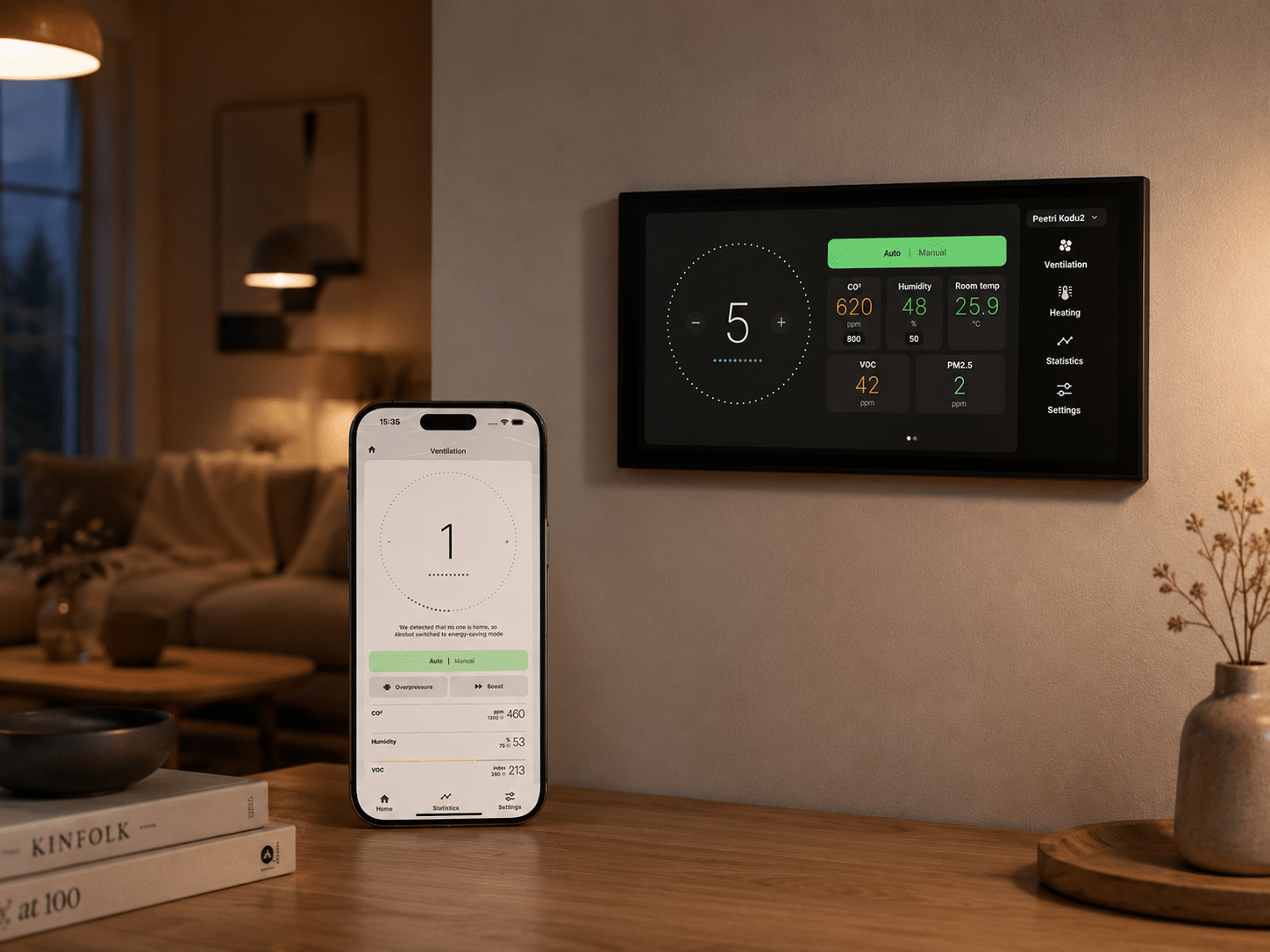
A lot still happens without you having to ask, too. Nobody home? Airobot switches to energy-saving mode on its own. Someone’s cooking and the kitchen fills with steam? Airflow increases automatically. And when it’s time to change your filters, you’ll get a reminder-on your phone and on the panel.
Free Updates. Real Support.
Airobot isn’t something you install once and forget about- in a good way. Every unit receives automatic software updates over the air, at no extra cost, for as long as you own it.
The system you have in a few years will do more than the one you installed, without you lifting a finger or paying a cent more.
And if something ever does go wrong, you’re not on your own. We’re not a typical ventilation manufacturer that disappears after the sale. Many issues can be spotted and resolved remotely, straight through the app, often through proactive maintenance alerts that catch a problem early. I
f you do need to reach a person, our support team is genuinely easy to get hold of and quick to respond. Every Airobot system also comes with a 2-year warranty as standard — extendable to 4 years simply by connecting it to the internet and registering it in the app within the first 6 months.
That’s the part most ventilation brands don’t tell you: buying the system is the easy part. Living with it for the next several years is what actually matters — and that’s exactly where Airobot is built to be different.
The Bottom Line
Yes, Airobot costs more on day one. But day one is the only true day. Every day after it, an Airobot MVHR system is working to bring that cost back down — through less wasted energy, healthier air, and a level of care most ventilation brands simply don’t offer.