Save 35% on electricity savings in space heating, supply air heating, and fan electricity costs with Airobot’s smart ventilation. Use our Annual Savings Calculator—backed by a TalTech study—to see how intelligent airflow control turns comfort into real energy savings while maintaining perfect indoor air quality.
Airobot
Premium MVHR. Cheaper to own.
Most ventilation systems quietly cost you thousands over their lifetime. Airobot is engineered to do the opposite — adapting to your home, your routine, and your weather, so it pays itself back faster than any system at its price point.
Calculate your savings with Airobot
Airobot with CO₂ sensors
and zonal ventilation
Zonal control – CO₂ control using room sensors in a dual-zone configuration. The house is divided into two ventilation zones, each regulated with dampers based on the highest CO₂ concentration within the respective zone, with a setpoint of 950 ppm.
Airobot with CO₂ sensors
in rooms
Central control – CO₂ control based on highest concentration measured across rooms – Sensors are installed in the bedrooms, office, and living room/kitchen, with a setpoint of 950 ppm.
Airobot with CO₂ sensor in the exhaust channel
Central control – CO₂ control via exhaust sensor –fan speed is adjusted based on CO₂ concentration measured in the ventilation unit extract air, with a setpoint of 600 ppm.
Standard
ventilation
ventilation
The ventilation unit operates at a fixed airflow rate regardless of occupancy or indoor conditions.
Savings
Savings
The average electricity price for medium‑size households in Estonia—including all taxes, levies, VAT, and fees—is approximately 0.23 € per kWh (as of December 2024) according to EUROSTAT.
Heating cost savings are calculated based on air-to-water heat pump with seasonal performance factor (SPF) of 2.9
- 0%
- 10%
- 20%
- 30%

Sticker price is the iceberg's tip.
Most MVHR comparisons hide 95% of the cost.
-

Fixed-speed operation
Conventional MVHR runs at full speed 24/7 — whether you're home or not. That's electricity you pay for, year after year, with no-one breathing the air.
-

No zonal awareness
Conventional systems treat your house as one zone. They heat and ventilate empty rooms while you sleep, work from a single room, or spend the weekend away.
-

Generic heat recovery
Most units claim 90% heat recovery — in the lab, in ideal conditions. Real homes have filters that clog, wind that gusts, and weather that changes. Generic systems don't adapt.
Airobot
Three reasons Airobot pays for itself.

30% lower electricity use
Airobot knows when nobody is home. Built-in CO₂, humidity and occupancy sensors drop the fan to minimum the moment a room, or the house is empty.

33% total electricity saving
Zonal ventilation directs air only where people are. Independent TalTech research measured 33% lower total electricity use and 18% lower heating energy compared to standard fixed-speed MVHR.

48% less supply air pre-heating
In cold UK winters, fresh air needs warming before it enters living spaces. Airobot's zonal system heats only the zones in use, educing pre-heating energy by nearly half.
How Airobot saves you money- without thinking about it.
-
Monitoring
Built-in sensors measure CO₂, humidity, temperature, VOCs and particulate matter- continuously.
-
Automomous decisions
Airobot's intelligence reads occupancy patterns and decides which zones need air, when, and how much. No manual programming.
-
Adapting
Dual-zone dampers direct fresh air only where it's needed. The bedrooms at night. The office during the day. Nothing wasted.


Not just a marketing fluff - backed by science
The TalTech Study Confirms
TalTech (Tallinn University of Technology) is one of Northern Europe’s leading engineering research institutions. They independently measured Airobot’s energy performance in real Nordic homes — in climatee conditions way harsher than the UK. If it works in Estonia, it works in Surrey.
The 33% electricity saving and 18% heating energy reduction quoted on this page come directly from their published study. You can read it in full below.
Answers to the questions you might be asking
Is MVHR really worth it?
For an airtight new build or renovation, mechanical ventilation is essential — you can’t just open windows without losing all your heat. The real question is which MVHR. A standard system might pay back in 8–12 years. An intelligent system like Airobot typically pays back in 4–5 years, based on real homes and independent measurement.
What's the payback period for Airobot?
For an average UK 4-bedroom new build, between 4 and 5 years. The exact number depends on your home size, occupancy pattern, electricity price and current heating type. Use the calculator above to see yours.
How does Airobot compare to premium MVHR brands?
At the unit level, premium MVHR brands are excellent and broadly comparable in price. The difference is what happens after installation. Most premium systems run at a fixed schedule. Airobot adapts continuously — to occupancy, air quality, and weather. That’s where the long-term savings come from. We’re not cheaper to buy. We’re cheaper to own.
Will zonal ventilation work in my house?
Zonal control works best in homes over 100 m² where occupancy varies through the day — bedrooms used only at night, home office only during work hours, living rooms in the evening. If everyone in your home is in one room all day, the savings are smaller. The calculator above accounts for this.
What does Airobot cost to install?
For an average 150 m² new build, expect £7,000–£9,000 including supply and commissioning — similar to other premium MVHR brands. Where Airobot differs is the lifetime cost: typically £5,000–£10,000 less over 20 years versus a fixed-speed equivalent.
Our products
Next generation heat- and energy recovery devices
Your system stays up to date on its own. Airobot devices get free automatic updates to keep everything running smoothly. And if something ever goes wrong (it hardly ever does), we fix 95% of issues remotely — no need to wait for a technician.

Next-generation ventilation
Enhance indoor air quality by reducing pollutants while saving energy with up to 96% heat recovery and intelligent optimization features.
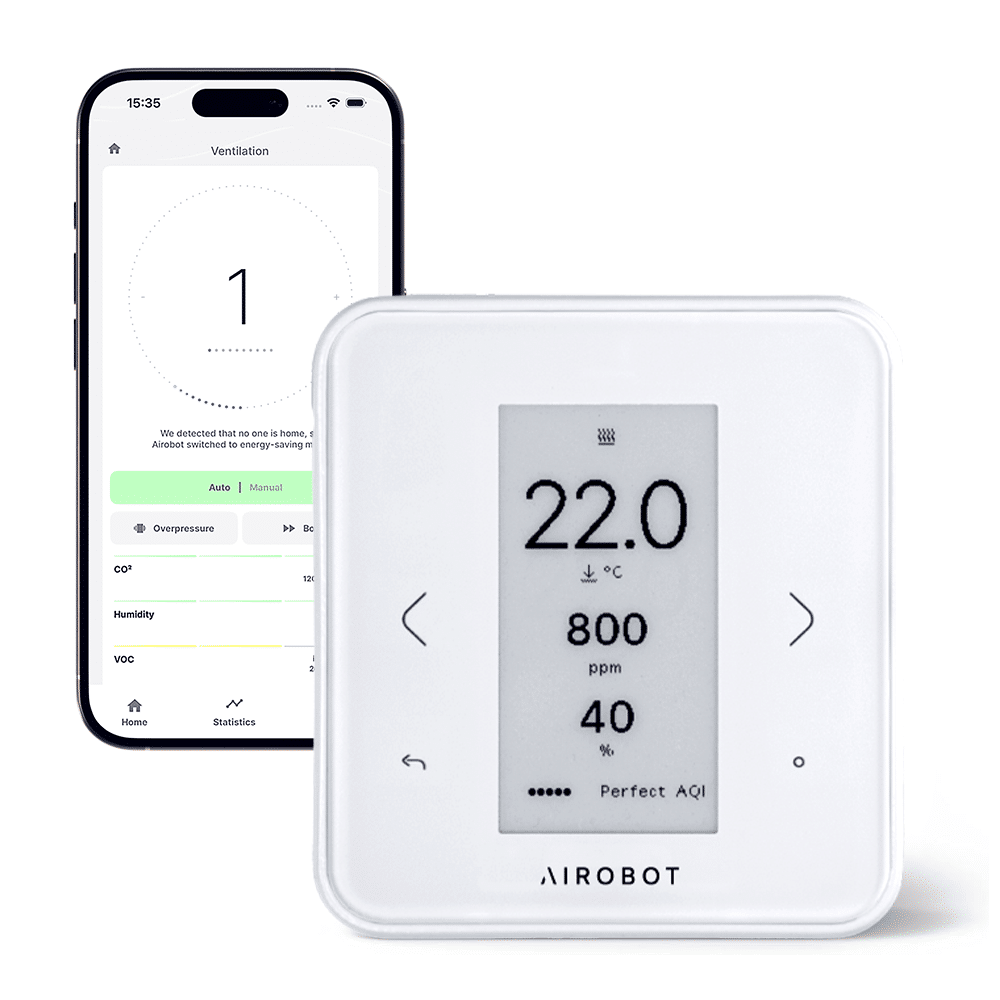
Intelligent heating control
For control of water- or electrical underfloor heating. Seamless integration with most floor heating systems.
Why Airobot
-

Made in EU
Designed, engineered and manufactured in Estonia, in the European Union — by a team that takes 24/7 ventilation seriously.
-

Independent research
Validated by TalTech (Tallinn University of Technology), one of Northern Europe's leading engineering institutions.
-

Lifetime developer support
Free firmware updates and developer-grade technical support for the lifetime of your unit. No subscription.